When someone needs a product or service today, one of the first things they often do is search online. They might search for a local service in Patiala, compare companies across Punjab, look for a provider somewhere in India, or search for a company serving customers in Australia. If your business doesn’t appear when potential customers are looking, you may be missing opportunities before a conversation even begins.
This is where SEO comes in.
SEO, or Search Engine Optimization, is the process of improving a website so that search engines can better understand its content and users can discover it through relevant organic searches.
For small businesses, SEO isn’t simply about ranking for popular keywords. It’s about being visible when the right people are searching for something your business can genuinely provide.
What Is SEO in Simple Terms?
SEO helps search engines understand three basic things:
- What your website is about
- Which searches your content is relevant to
- Whether your website provides a useful experience for visitors
Imagine you run a web design business.
Someone searches for “website design company in Patiala.”
Another person may search for “website design services India.”
A business owner in Australia might search for a company that provides website design, development, SEO, or digital marketing services. These searches are different, but they have one thing in common: the person is actively looking for information, a service, or a solution. A good SEO strategy helps your website become easier to discover for searches that are relevant to your business. Google’s guidance emphasizes creating helpful, reliable, people-first content rather than producing content primarily to manipulate search rankings.
How Does SEO Work?
SEO isn’t one single activity. It involves several areas working together, including content, website structure, technical performance, search intent, internal linking, local visibility, and overall user experience.
A simplified SEO process looks like this:
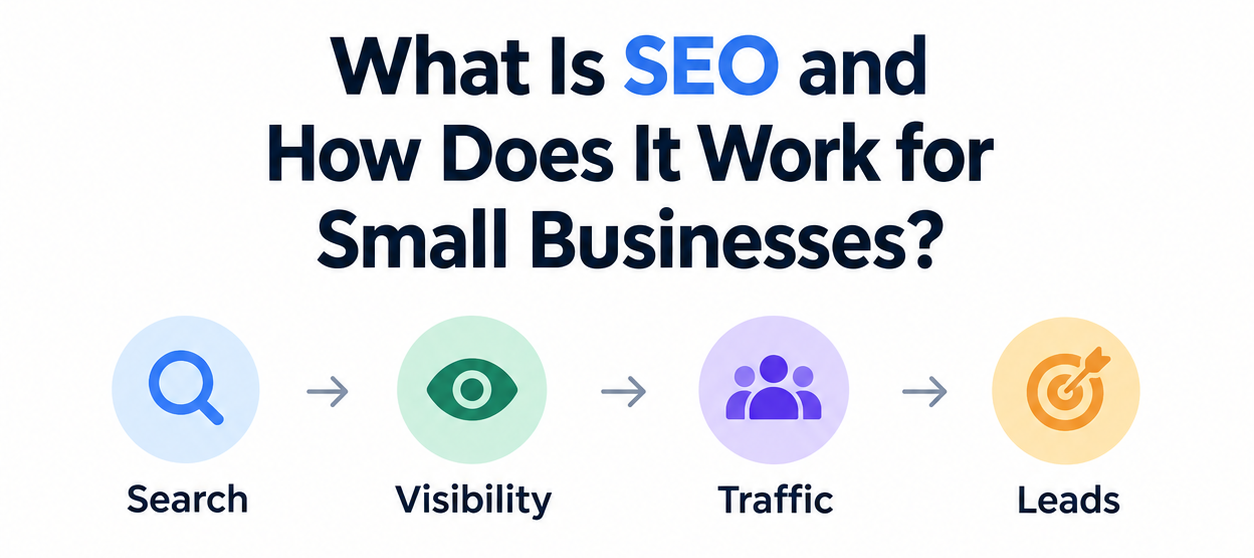
Understand what people search for → create useful content → optimize the website → make pages accessible to search engines → build relevance and trust → measure performance → improve over time.
Each part matters.
1. Start With Search Intent
Before creating a page, you need to understand why someone is searching.
For example:
“What is SEO?”
This is primarily an informational search.
The person wants to learn.
But:
“SEO company in India”
has a different intent.
The searcher may be comparing companies or looking for professional help. Someone searching for SEO services in Australia may have a similar commercial intent but a completely different geographic market. Understanding this difference is important because the content should match what the searcher actually wants. A blog article shouldn’t behave like a sales page, and a service page shouldn’t read like a general encyclopedia article.
2. Choose Relevant Keywords
Keywords are the words and phrases people use when searching. For a small business, these could include:
- SEO services
- local SEO
- website design company
- digital marketing services
- web development company
- SEO company in India
- website design services India
For businesses targeting different markets, location can also become relevant. A company serving customers in Patiala may target local searches, while a business operating across India may focus on national search visibility. A company offering services in Australia may need to consider Australian audiences and location-specific search behaviour. But effective SEO isn’t about repeating a keyword as many times as possible. Search engines have become much better at understanding topics, relationships, context, and intent. The better approach is to create useful content around the subject and naturally include relevant terms where they make sense.
3. Create Useful Content
Content is one of the most visible parts of SEO.
For a small business, useful content can include:
- Service pages
- Blog articles
- FAQs
- Guides
- Location pages
- Case studies
- Industry pages
- Comparison articles
The important word is useful.
Publishing ten short articles that say almost nothing isn’t necessarily better than publishing three detailed resources that genuinely answer customer questions.
For example, if a business provides Web Development Company services, its website should explain what those services involve, who they are suitable for, what problems they solve, and what a potential customer can do next.
That gives both visitors and search engines a clearer understanding of the page.
4. Improve On-Page SEO
On-page SEO refers to improvements made directly to a webpage. This can include:
- Page title
- H1 heading
- Subheadings
- Page content
- URL structure
- Internal links
- Image alt text
- Relevant keywords
- Content organization
- Meta description
The purpose isn’t to make a page look “optimized” to a search engine. The purpose is to make the page clearer. A well-structured page helps visitors quickly understand what they are looking at and helps search engines interpret the subject of the page.
5. Don’t Ignore Technical SEO
Sometimes a website has excellent content but still has technical problems. Technical SEO deals with the parts of a website that affect how effectively search engines can access, crawl, understand, and index it.
This can involve:
- Mobile usability
- Page speed
- Crawlability
- Indexability
- XML sitemaps
- Canonical URLs
- Redirects
- Broken links
- HTTPS
- Structured data
- Website architecture
For example, Google explains that pages need to be accessible to crawling and indexing if they are to appear in search results.
Technical SEO may not be the most exciting part of digital marketing, but ignoring it can create problems that aren’t immediately visible to a business owner.
6. Local and International SEO Can Matter
SEO strategy should reflect where a business actually serves customers. For a local business in Patiala, local search visibility may be a major priority. A company serving customers throughout Punjab may need broader regional content and visibility. A business targeting customers across India may focus on national search opportunities and industry-specific searches. And if a company provides services in Australia, its SEO strategy should also consider the Australian audience, local search behaviour, relevant locations, and the competitive environment in that market.
This is important because SEO isn’t one-size-fits-all. The same business can have different search opportunities depending on the market it wants to reach.
Dotoit provides digital services to businesses in Patiala and across Punjab, throughout India, and in Australia. That wider service reach makes it important to think about SEO according to the audience and market a business is actually trying to reach.
This doesn’t mean creating dozens of pages that simply replace one location name with another. Each location-focused page should provide genuine value and relevant information for the people searching in that market.
7. User Experience and SEO Work Together
Getting someone to your website is only part of the journey.
What happens after they arrive?
Imagine a person searches for a service and clicks your website.
If the page takes too long to load, looks confusing on mobile, has unclear navigation, or doesn’t explain the service properly, the visitor may leave.
This is why SEO and user experience shouldn’t be treated as completely separate disciplines.
For example, UI UX design services can help businesses think about how people interact with a website, while SEO focuses on helping the right audience discover relevant pages.
The two can support each other.
A website should be easy to find and easy to use.
How Does SEO Help a Small Business?
One of the biggest advantages of SEO is that it can help a smaller business compete for relevant searches without relying entirely on paid advertising.
Suppose someone searches for a service you provide.
If your website has a relevant page that clearly answers their needs, you have an opportunity to appear in that search journey.
That doesn’t guarantee a first-page position or a customer.
But it creates the opportunity to be discovered.
For a small business, that can be valuable because search traffic can continue to bring visitors to useful content after the initial publication.
SEO Is Not Just About Rankings
A common mistake is to measure SEO only by ranking positions.
Rankings matter, but they aren’t the complete picture.
Consider two situations.
Business A ranks for hundreds of searches but receives little relevant traffic.
Business B ranks for fewer searches but attracts visitors who actually need its services.
Which one is generating more valuable visibility?
This is why businesses should also look at metrics such as:
- Organic traffic
- Search impressions
- Clicks
- Qualified leads
- Contact form submissions
- Phone enquiries
- Conversions
- Engagement
The goal isn’t traffic for the sake of traffic.
The goal is relevant visibility that supports business growth.
How Long Does SEO Take to Work?
There isn’t one guaranteed SEO timeline.
Some improvements may produce noticeable changes relatively quickly, while competitive searches can take much longer.
The timeframe can depend on:
- Competition
- Website history
- Technical condition
- Content quality
- Search demand
- Industry
- Location
- Existing authority
- Consistency of optimization
This is why businesses should be careful with promises such as “number one on Google in 30 days.”
Good SEO is a process of research, implementation, measurement, and refinement.
Common SEO Mistakes Small Businesses Should Avoid
Keyword stuffing
Repeating the same keyword unnecessarily can make content awkward and difficult to read.
Creating content without a purpose
Not every business needs hundreds of blog posts.
Each piece should serve a clear audience and search intent.
Ignoring mobile users
A page that works beautifully on a desktop can still provide a poor experience on a smartphone.
Forgetting the website itself
SEO may bring visitors, but your website still needs to convince them to stay, explore, and take action.
Focusing only on rankings
A ranking without relevant traffic or enquiries doesn’t necessarily create business value.
Expecting instant results
SEO is rarely a one-week project. It requires consistent improvement.
Can Small Businesses Do SEO Themselves?
Yes.
A small business can handle many basic SEO activities internally.
For example, you can:
- Research customer questions
- Improve page titles
- Create useful content
- Fix obvious broken links
- Improve internal linking
- Keep business information accurate
- Monitor search performance
However, SEO can become more complicated as competition increases.
Technical problems, content strategy, competitive research, website structure, local SEO, and performance analysis can require more specialized knowledge.
This is where professional support can make sense.
Dotoit provides SEO services as part of its broader digital solutions, helping businesses approach search visibility alongside their website, content, and digital marketing goals.
SEO Should Support the Whole Digital Strategy
SEO shouldn’t exist in isolation. A business may need a strong website, useful content, good user experience, digital marketing, and a clear conversion path. For example, a company may discover your website through search, explore your services, read your content, check your work, and eventually contact you.
Every stage matters. Dotoit provides services for businesses in Patiala, across Punjab, throughout India, and in Australia, so the right digital strategy can vary depending on the audience and market being targeted. For one business, local visibility may be the priority. For another, national search visibility may matter more. For a business targeting Australia, the strategy may need to account for Australian customers and their specific search behaviour.
For businesses looking beyond SEO alone, Dotoit’s Digital Marketing Company India services can also form part of a broader online growth strategy.
When Should a Small Business Invest in SEO?
Professional SEO support can be worth considering when:
- Your website receives little organic traffic
- Your competitors consistently appear above you
- Important service pages aren’t getting visibility
- You don’t know which keywords to target
- Your website has technical issues
- You want to expand into new locations
- You want more qualified organic enquiries
- You don’t have the time to manage SEO consistently
The first step doesn’t necessarily need to be a complete SEO campaign.
Sometimes, a website and SEO audit can simply identify what is already working, what is holding the website back, and where the biggest opportunities are.
Frequently Asked Questions
How can SEO help my business get more enquiries?
SEO can help your business appear when potential customers are actively searching for the products or services you offer. The right strategy focuses on relevant, high-intent searches rather than simply increasing website traffic. Dotoit Web Builders can help identify these opportunities and optimise your website around them.
How much does SEO cost for a small business?
SEO costs depend on factors such as your industry, competition, target locations, website condition, number of pages, and the level of optimisation required. Instead of assuming every business needs the same package, Dotoit Web Builders can assess your website and business goals to determine what type of SEO work is appropriate.
How long does it take to see SEO results?
There is no guaranteed timeline for SEO. Results can depend on competition, website authority, technical issues, content quality, search demand, and the keywords being targeted. Some improvements may appear relatively quickly, while stronger organic visibility usually requires consistent work over time.
Can you help my business rank in Patiala?
Yes. If your business serves customers in Patiala, a local SEO strategy can target relevant searches related to your services and location. Dotoit Web Builders can work on areas such as website optimisation, location-focused content, local search signals, and relevant commercial keywords.
I already have a website. Do I need SEO?
Having a website does not automatically mean potential customers will find it through Google. If your website is receiving little organic traffic or enquiries, an SEO audit can help identify issues with keywords, content, technical SEO, page structure, local visibility, and search intent.
My website gets traffic but no enquiries. Can SEO help?
It can. Traffic alone does not guarantee business results. If visitors are coming through irrelevant keywords, landing on weak pages, or struggling to understand your services, the problem may involve both SEO and conversion strategy. Dotoit Web Builders can help identify whether the issue is search intent, website content, user experience, or the enquiry journey.
Can SEO help me compete with businesses already ranking on Google?
Yes, but the strategy should be based on what your competitors are doing and where realistic opportunities exist. This can include analysing their keywords, content, website structure, local visibility, backlinks, and commercial landing pages, then identifying gaps your business can target.
Do I need local SEO if I only serve customers in my city?
If most of your customers are local, local SEO can be particularly valuable. Searches such as “SEO company in Patiala,” “website designer near me,” or “[service] in Patiala” indicate that the searcher may already have a specific need and location in mind.
Can Dotoit help with both website design and SEO?
Yes. Dotoit Web Builders provides website design and SEO services, which can be useful when a website needs both a stronger user experience and better search visibility. Building SEO considerations into the website structure can also reduce the need to fix avoidable issues later.
Can you do SEO for businesses targeting customers outside India?
Yes. SEO can be planned around different countries, cities, audiences, search behaviour, and levels of competition. If your business targets customers in Australia, Canada, or another market, the keyword and content strategy should be developed specifically for that audience rather than simply translating an India-focused strategy.
What should I do before hiring an SEO company?
Ask what will actually be done, which keywords and pages will be targeted, how progress will be measured, how technical issues will be handled, and how SEO activity will connect to business enquiries. You should also avoid anyone promising guaranteed Google rankings, because search rankings depend on factors outside an agency’s direct control.
How do I get started with SEO for my business?
The best starting point is usually a website and search visibility assessment. Dotoit Web Builders can review your current website, target audience, services, locations, competitors, and SEO opportunities before recommending the next steps. This helps ensure that the SEO strategy is based on your actual business goals rather than generic optimisation.
Get Started with SEO for Your Business
SEO doesn’t have to be mysterious. At its core, it is about helping the right people discover the right information at the right moment.
For a small business, that means understanding what potential customers search for, creating genuinely useful content, maintaining a technically sound website, building relevant visibility, and measuring whether that visibility is producing meaningful results.
Whether your audience is in Patiala, across Punjab, throughout India, or in Australia, the principle remains the same:
Be useful. Be relevant. Be easy to find. And give visitors a reason to stay.
Dotoit provides digital services across these markets, combining SEO with website development, design, UX, and digital marketing to help businesses build a stronger online presence. SEO may bring someone to your website. What you do with that opportunity is up to the website, the content, and the business behind it.